

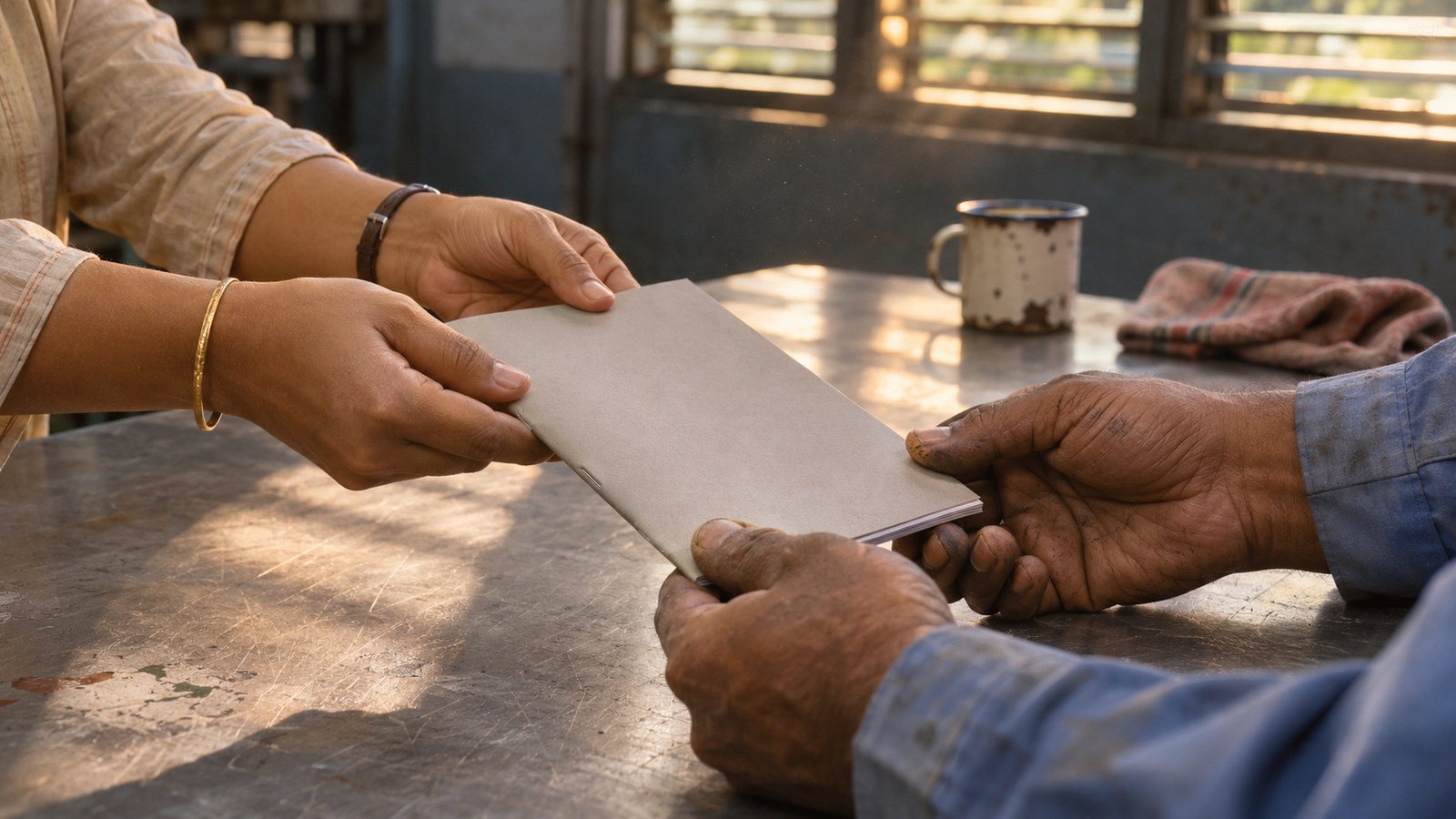
The deck arrived in Tamil. All 186 slides, checked by the site HR lead who reads Tamil at home and English at work. The sessions ran well. People nodded, asked two questions, filled the feedback sheet.
Two weeks later a shift supervisor asked three operators to walk him through the escalation step. He got three different sequences.
The one who had it right could not say it in the words on the practice card, because the card was in English. Nobody had translated it. The deck was the deliverable, and the card was not.
The translation budget lands on the wrong object
Open a rollout proposal and look at what is priced: a deck counted in slides, a guide counted in pages, a workbook. Those line items are what get localised, because localisation is bought against an invoice.
The artefacts that carry the behaviour are not on the invoice. The behaviour anchors sit inside a competency framework signed off two years ago. The practice scripts live in a guide the client never opens. The observation form is filed under assessment materials. So the deck gets a careful Tamil translation and the anchor stays in English, read aloud by a trainer who then paraphrases it, and the drift starts there.
There is a second reason. Following a lecture in a second language is possible. Producing a sentence in it under pressure is a different task. A man who understood every slide can have no words when a customer is shouting at the counter or a line has stopped. The sentence he needs is the one he would use at tea, and it must be rehearsed there.
It is not a matter of taste where training is regulated. OSHA’s policy statement is that required training must be presented in a language and vocabulary employees understand, and that telling a worker who is not literate to read the materials does not discharge it. Borrow it where no Indian statute says it.
The evidence is mostly from schooling, not the shopfloor, so be straight about that. UNESCO puts the share of people without access to education in a language they speak fluently at 40 per cent worldwide, rising to 90 per cent in some low and middle income countries, with more than a quarter of a billion learners affected. A corporate cohort is narrower and usually literate. Same mechanism, smaller scale, cheaper fix: nine sentences, not a curriculum.
The state is not the site
“We are doing Tamil Nadu in Tamil” is a guess about a crew, not a fact about a state. Census 2011 counted 121 languages with more than 10,000 speakers, 270 identifiable mother tongues and 22 scheduled languages, with 96.71 per cent of the population reporting a scheduled language as mother tongue. A plant in the Hosur belt can run on Odia contract labour with Tamil supervisors and a Kannada-speaking maintenance team. A warehouse outside Pune can be majority Hindi on the floor and Marathi in the office.
So the language comes from the cohort list, not from the pin on the map. Ask site HR for two columns: name, mother tongue. If the list does not exist, a show of hands at the briefing does the same job. Then apply one threshold: the language covering at least 80 per cent of the batch. Below that you are not choosing a language, you are running bilingual, which changes the trainer count rather than the translation.
The 20 per cent outside it decide whether the programme worked: they nod through a session in their third language and do the old thing on the floor. Handle them by pairing, not translation, one bilingual worker per table, briefed before the session.
Four boxes for every printed artefact
List every artefact the programme prints and put each in a box. The decision is per artefact, and that is where the money is saved.
| Artefact | Decision | Why |
|---|---|---|
| Behaviour anchors | Translate, then back-translate and validate | This is the sentence a manager rates a person against |
| Practice scripts | Translate, and rehearse aloud in the local language | The learner has to produce these under pressure, not read them |
| Observation and evidence form | Translate the behaviour column, keep the codes | Raters at six sites must score the same thing |
| Job titles, SOP codes, machine names | Keep exactly as spoken on the floor | A second vocabulary means nobody recognises the job being described |
| Pre-read theory, policy text | English, with a local read-aloud in the first ten minutes | Comprehension is checked rather than assumed |
| Full slide deck | Do not translate page by page | 180 slides of translated bullets teach nothing that survives a week |
| Glossary or lexicon | Do not build one | It becomes a third language nobody speaks |
The last two rows are the uncomfortable ones, because they are what the client pays for. A translated deck feels like progress. A translated practice card is invisible until someone is standing in front of a stopped line.
The order matters as much as the boxes. Anchors first, because everything downstream is written against them. Practice scripts second, because they are what the learner says out loud. The evidence form third, because it decides whether scores from six sites can be compared. Administration last, and usually not at all.
Fifteen minutes per anchor: the back-translation test
A translated anchor is not validated because a translator signed it off. It is validated when a second person, working cold, turns it back into the language it came from and lands on the same behaviour.
The translator reads the English anchor and says the local version out loud, without a dictionary. A second person who has not seen the English hears only that and translates it back. Compare the two English sentences.
Same behaviour, same conditions. Use it. Done.
Same behaviour, different conditions. This is the common failure and the expensive one. “When a customer raises a complaint” and “when a customer is upset” are not the same trigger, and two raters working from the second version will disagree all year. The fault is usually in the English anchor, not the translation, so tighten the English and run the test again. The test for whether an anchor can be observed at all is set out in how to write behavioural anchors a manager can actually observe.
Different behaviour. Stop. An anchor that comes back as a different action was written as an attitude, and an attitude cannot be rated in any language.
Nine anchors is half a working day, including the rewrites. Do it before the translator is booked for volume, because half of what you find is a design problem wearing a language problem’s clothes.
Brief the bilingual peer for 45 minutes
Pairing works only if the peer has been told what the job is.
The four sentences that carry a session: say that in your own words; say it the way you would say it to your supervisor; that is the right idea, now use these words; stop me if this word means nothing.
The first rule is the stop rule. If you cannot translate a word, do the action instead of inventing one. A demonstrated step survives. An invented word becomes a rumour on the floor by Thursday.
The second rule is the list. Write down every word you could not translate. Collected from six sites, that list is the only glossary worth having.
A worked example, illustrative
A three-module programme for a six-site manufacturer: 640 learners, five languages, 9 anchors, 6 practice scripts, one two-page evidence form. The figures are constructed to show the arithmetic, not measured.
Artefact translation is 23 pages per language: nine anchors, twelve pages of scripts, two pages of form. Across five languages that is 115 pages, plus 15 per cent rework, so about 132. At six pages an hour including review, 22 hours, three working days.
The deck is 186 slides. Across five languages that is 930 slide-pages and 155 hours, five weeks, plus a maintenance liability: the deck changes every quarter and the anchors do not.
Then the delivery arithmetic, where the real money sits. 640 learners in batches of 20 is 32 batches. In-language delivery holds a three-hour module in three hours, so two batches fit a trainer day: 16 trainer-days. Live interpretation runs about a third longer, leaving one clean batch per day, so 32 trainer-days plus interpreter fees. The translated scripts buy back 16 trainer-days for 22 hours of work.
The evidence form is the part clients underestimate. Where two of six sites ran in English with interpretation, the communication dimension scored lower there than at the four local-language sites, on candidates the assessors called equally clear in their own language. The point is not the number. Those six sites were never comparable, and the report treated them as if they were.
Where this stops working
Translation does not fix literacy. If a third of the crew cannot read the practice card, the card is not the artefact, the paired rehearsal is. Ask first: can each person read a two-line instruction in their own language? If not, you are designing for oral delivery and the card is a prompt for the trainer.
It does not fix a mixed metro site either. Where no language reaches 80 per cent, bilingual delivery doubles trainer time, which is a proposal decision rather than a room decision.
And it does not rescue a weak trainer. A trainer who cannot read a room will deliver a flat session in perfect Tamil. Language removes one barrier, not the others.
Language work is cheap, unglamorous and front-loaded. Decide it before the trainer is booked and before the deck goes for localisation, because after that the money is spent on the wrong pages.
Monday morning
Take the next rollout and print the artefact list: every document the programme puts in front of a learner or a rater. Put each one in a box. The pages in the translate box are your quote, not the slide count.
Then run the back-translation test on the first three anchors, with two people from the site and one who has never seen the English. If two come back with a different trigger condition, you found a design problem before it cost six sites.
If the framework needs rewriting before it can be translated, that is competency framework work rather than a language job, and it is worth doing once. For delivery, including how the language choice interacts with pan-India rollout design, the rule holds: decide the artefact before the vendor.
Sources
https://www.unesco.org/en/languages-education https://indianexpress.com/article/india/more-than-19500-mother-tongues-spoken-in-india-census-5241056 https://www.osha.gov/dep/standards-policy-statement-memo-04-28-10.html