

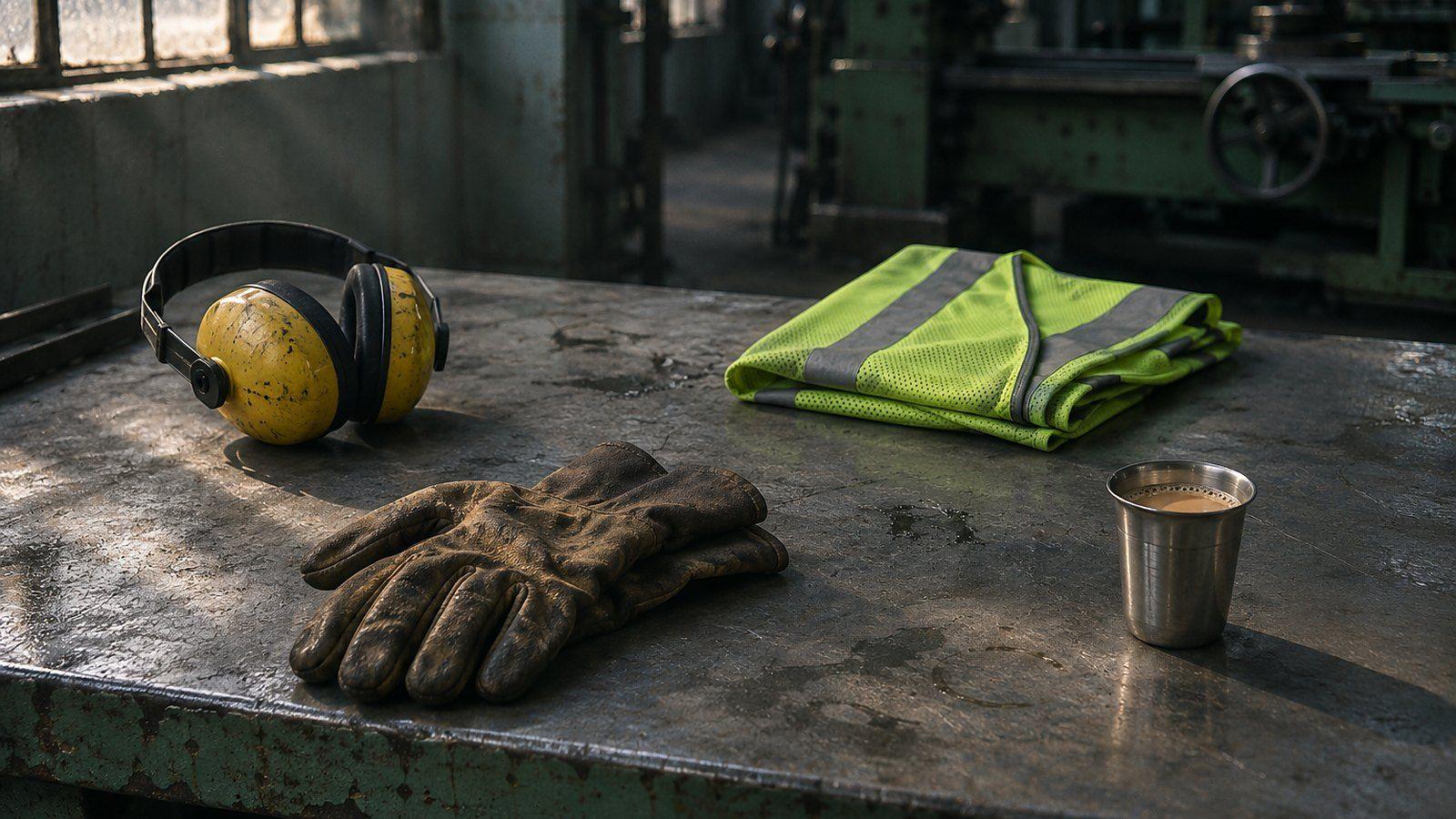
The trainer arrives at 9.10 for a 9.30 start. The room is a corner of the stores area, the compressor is running, and eighteen people are standing because the chairs went to the other shift. Half the group came off nights four hours ago. The deck has forty-two slides on communication styles. Nobody will remember the third one.
That is not a trainer problem. It is a brief problem. Somebody sent a syllabus where a constraint sheet was needed.
Three constraints a classroom brief ignores
Plant work is bounded by law, noise and rotation. Each one changes the design before a single slide is written.
Time. Under the Factories Act, 1948, an adult worker in a factory cannot be required or allowed to work more than 48 hours in a week or nine hours in a day. No single work period may exceed five hours without a rest interval of at least half an hour, and the working period including rest may not spread over more than ten and a half hours in a day, or twelve with the Chief Inspector’s written permission. A forty-minute slot is therefore not a small classroom session. It is a slice cut out of a fixed legal envelope, usually taken from the end of a shift when attention is lowest, or from the changeover when everyone is waiting for the gate.
Noise. Noise is not background. OSHA’s guidance says exposures at or above 85 decibels as an eight-hour average require a hearing conservation programme, and training is one of its main elements. It also offers a rough field test: if you have to raise your voice to be heard by someone three feet away, the level may already be above 85 dBA. In a press shop or a packaging hall the trainer is competing with the machine. If hearing protection stays on during the session, a voice-led briefing is mostly mime.
Rotation. The people in the room are half the population. The other shift learns from whoever they trust at handover, not from your slide. A brief that covers one shift covers half the site and leaves two versions of the truth: what the trainer said, and what the day shift heard the night shift said. Any training delivery plan should start from that.
Get the window before you write the content
Most briefs are written from a training calendar. Write this one from the rota.
Ask the shift supervisor two questions before you book anything: which forty minutes are actually free this week, and who is on leave or light duty. Then write the window into the brief as a fact. “Thursday, 14.20 to 15.00, B shift, before handover” is a fact. “Thursday afternoon, one hour, shopfloor” is a wish.
Forty minutes is not a duration. It is an arithmetic limit. Divide it by headcount. With eighteen people, that is a little over two minutes each if every person is to touch the object once. Two minutes per person buys one behaviour and one check. It does not buy three behaviours, a video, a group activity and a feedback form. If the client wants all four, the answer is a second window, not a faster trainer.
Two rules follow. Put the session inside paid time, never on the far side of a shift, or you are asking people to choose between training and the bus home. And avoid the last twenty minutes of a physical shift, when the queue, the cleanup and the fatigue arrive together.
Cut to one behaviour, one object, one check
The brief has to name what the person will do differently, what they will hold, and what the supervisor gets back. Everything else is enrichment.
| Field | Classroom brief | Plant-floor brief |
|---|---|---|
| Who | “shopfloor staff, about 20” | 11 operators from B shift, 9 from C, 3 on light duty |
| Outcome | “improve safety ownership” | “checks the guard interlock before the first stroke of every cycle” |
| Props | laptop, deck, workbook | the guard, the interlock, the check sheet |
| Evidence | feedback form | 9 of 11 demonstrate unaided; sheet photographed |
| Follow-up | none | ten-minute retrieval at the next handover |
The outcome line is the hard one. “Checks the guard interlock before the first stroke” can be watched. “Improve safety ownership” cannot, and a trainer who is handed an unobservable outcome will fill the gap with talk. If the client cannot name a behaviour that happens at a known moment in the shift, the programme is not ready for a plant-floor session. Send it back to scoping.
Write the six fields
A usable brief fits on one page, and the trainer should be able to read it in the cab on the way in. Six fields.
- Window. Date, start and end time, shift, and the name of the person who has released the group. Without a name, the release is a rumour.
- Room. The room, the distance from the line, and whether the group can hear a normal speaking voice there. If not, the plan changes before the trainer arrives.
- Who is in the room. Headcount, shift mix, languages, and how many have done the task before. Do not write “operators”. Write “nine fitters who set the machine and two helpers who load it”, because the trainer’s examples depend on it.
- One behaviour, with a finish. A verb, a setting and a visible end state. “Before the first stroke, presses the interlock check and waits for the green light” has a finish. “Is more careful” does not.
- The object. The real guard, the real valve, the real sheet. Not a photograph of it, if the real one can be carried in.
- The return. What comes back to the supervisor by Friday: names of the people who demonstrated unaided, a photograph of the completed check sheet, and the two questions the group could not answer.
Field six is the one most briefs omit, and it is the reason plant training disappears. If nothing returns, the supervisor has no reason to ask about the behaviour next week, and the trainer has no way to know whether the session worked.
Put the object in the trainer’s hands
A plant-floor session should be built around demonstration and repetition, not explanation. The trainer shows the check, a worker does it, the trainer corrects one thing, the worker does it again. Then the next person.
This is also where the spacing evidence applies. The Australian Education Research Organisation’s practice guide summarises the finding plainly: spacing learning across two or more sessions produces better long-term retention than concentrating it into one, and retrieval from memory does more for retention than rereading the same material. A single forty-minute block is the massed version, the one the evidence treats as the weaker option. The brief should therefore schedule a second touch: a ten-minute recall at the next handover, where the shift lead asks two people to walk through the check without notes. That is cheap, and it is the part most likely to be dropped when the programme gets busy.
Cover the second shift without a second session
The tempting fix is to run the session twice. The cheaper fix is to make the shift lead a second trainer.
Give the shift lead the same one-page brief, thirty minutes of practice on the object, and the three lines they will use at handover. This is the same principle as the handover document internal trainers actually use: the artefact has to survive contact with a real cohort, which means one page, not ninety. A shift lead who can demonstrate the check and correct one error will hold the standard better than a trainer who visits once a quarter.
The same logic scales across plants. Running one programme across many sites without twenty variations depends on deciding what is fixed centrally, such as the behaviour and the return, and what is local, such as the window and the language.
Worked example: a press brake check
Illustrative example. A fabrication unit has two shifts and 34 operators on the press brake line. The safety team wants “better guard awareness” after two near misses. That phrase cannot be briefed, so it becomes one behaviour: before the first stroke of a new job, the operator checks that the guard interlock stops the stroke and records the check.
The window is 40 minutes at 14.20, before handover, with B shift. Eleven operators attend in two groups because the line cannot stop completely. The trainer brings a de-energised brake, the interlock key and the paper check sheet. Each operator performs the check twice, once with the trainer watching and once with a colleague watching. Nine of the eleven do it unaided by the second attempt. Two hesitate on the reset step.
The return to the supervisor is one page: the nine names, a photograph of the sheet, and the reset-step question. The shift lead practises the same check for 30 minutes and runs the ten-minute recall at the next handover with C shift. In week two, the supervisor watches three first strokes per shift and records whether the check happened before the stroke rather than after.
Every number here is invented to show the shape of the work. None of it is a client result or a benchmark. The useful part is the structure: a named window, one behaviour, an object, a demonstration count and a return someone actually reads.
Where the brief stops
A good brief makes a trainer effective. It cannot make a wrong procedure right. If the standard operating procedure is out of date, a tighter session teaches the error faster and with more confidence. Check the procedure against the machine before you brief anyone.
It also cannot compress a skill that needs hours of practice into forty minutes. Guard checks and handover routines fit the format because they are short, repeated and observable. Diagnosing a hydraulic fault does not. For that, the honest answer is several short sessions across a month, on the machine, with the same trainer returning. Programme design should carry that cost openly rather than hiding it inside a packed agenda.
And training is not a noise control. OSHA requires engineering or administrative controls once exposure exceeds 90 dBA as an eight-hour average, and a briefing does not substitute for either. If the site is loud enough that people keep their protection on during the session, the location is the design problem, not the trainer’s delivery.
What to do on Monday
Take the next plant-floor programme on your list and rewrite the brief on one page with the six fields. Then ring the shift supervisor before you confirm the trainer, and get the window and the release name in writing. If the supervisor cannot name a forty-minute slot inside paid time, do not book the session yet. You have just found the real constraint, and it is cheaper to solve it now than to watch eighteen people stand in a stores corner listening to slide three.
Sources
- https://www.dgms.gov.in/writereaddata/UploadFile/The_Factories_Act-1948.pdf
- https://www.osha.gov/noise
- https://www.edresearch.edu.au/guides-resources/practice-guides/spacing-and-retrieval-practice-guide-full-publication